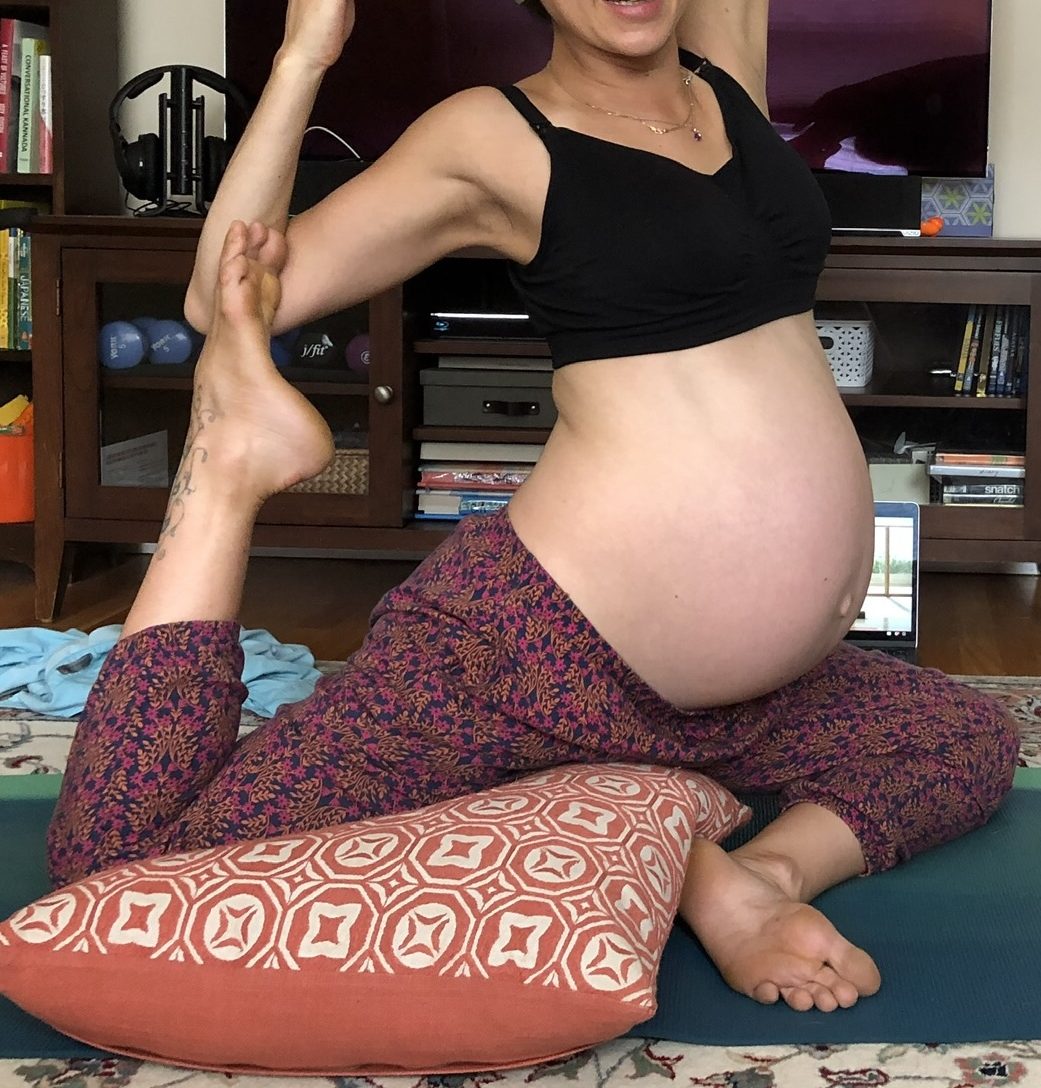
The start of my second pregnancy was the same as my first; extreme nausea, vomiting, and fatigue that lasted a few weeks into my second trimester. I didn’t do much other than take care of my toddler, sleep, snuggle with my dogs, and just wait for the miserable feeling to pass. At around 17 weeks I gained back some energy and finally had it in me to start doing yoga and exercise. How I had missed having the energy and strength for this!
I got into a nice prenatal exercise routine only to find out at the 20 week anatomy scan that I had placenta previa – a condition when the placenta covers the opening of the mother’s cervix. I was advised to do little to no exercise, avoid any form of vaginal penetration, and that I’d need to be monitored more closely in the later half of my pregnancy. The complications of placenta previa are:
- Bleeding: severe and potentially life-threatening vaginal bleeding/hemorrhage during the pregnancy, labor, delivery or in the first few hours after delivery.
- Preterm birth: severe bleeding can lead to an emergency C-section before the baby is full term (this almost happened twice with my third son)
- Placenta accreta spectrum: placenta previa is associated with a group of conditions called placenta accreta spectrum in which the placenta can grow into or through the wall of the uterus. Placenta accreta has a high risk of bleeding during pregnancy and during or after delivery.
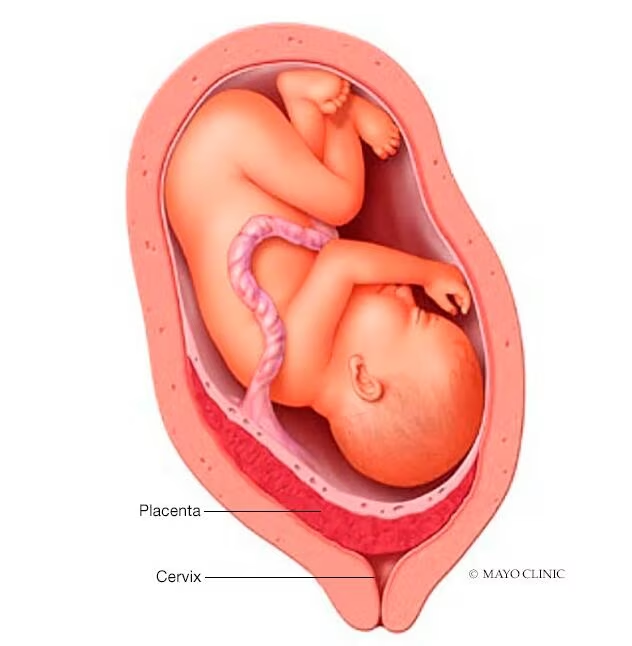
Photo from Mayo Clinic
The OBGYN said that there is a high chance the previa would resolve later in pregnancy but in the case that it doesn’t, a scheduled C-section would be necessary. I was unbelievably disappointed with this news but I searched and found some gentle prenatal yoga classes that worked well for this situation. I found that even just mild exercise/stretching helped keep my worries at bay. I had raging pregnancy hormones and I really needed something to help keep me grounded and moving my body in a mindful way did just that.
After 30 weeks gestation, I had biweekly ultrasounds to check on the previa and at 34 weeks, the radiologist told me that it was very unlikely the previa would resolve because my cervix was still mostly covered by the placenta. She suggested I go ahead and schedule my C-section at 37 weeks gestation (they don’t want women with unresolved placenta previa to go into labor naturally so they generally schedule a C-section in the 37th week because chances of spontaneous labor occurring after 37 weeks are high) but told me I had the choice of giving it one last look with an ultrasound at 36 weeks. It was highly doubtful the placenta would move much this late in pregnancy, she warned, but I jumped on the opportunity and schedule the final ultrasound. There was no harm in checking (I say this because I had health insurance to cover the cost of these ultrasounds), I thought, and in the unlikely chance it is resolved, I’d get to avoid an unnecessary C-section. What did I have to lose?
Thank goodness I opted for the ultrasound because by 36 weeks the placenta was no longer obstructing my cervix and I was given the green light for a natural delivery! It was a miracle! We were all so surprised, including the radiologist and my midwife.
Now, this was all in the midst of the COVID-19 pandemic in 2020 and between COVID-19 and the previa, my husband and I had decided there was no point in hiring a doula. The birth of our first son was wonderful (at least in my memory) thanks to the doula we hired and I was feeling pretty nervous about having a natural birth without the support of a doula. But yet again, fate was on our side and Massachusetts began allowing a second support person in labor & delivery right before my due date (I was due on August 31). Right around that time, a prenatal massage therapist that I had met once early in my pregnancy reached out to me asking if I needed a doula. She was getting a DONA international doula certificate and needed to attend a few births for credit towards her certificate. Since she had reached out to us and because this was for the completion of her certificate, she didn’t charge her usual doula fees and asked for a donation, any amount we were comfortable with (we ended up paying her $500). Wow! How did we get so lucky? I was so shocked that things fell into place like that. It all felt too good to be true.
Everything finally felt clearer now and all I had to do was just wait. At 39 weeks gestation, I started getting contractions that continued to progress as the hours went by. At around 9pm, I was admitted to the hospital and was about 5 cm dilated. My water had not yet broken and one of the first things the midwife on duty told me was that she could break my water to speed up the process. She warned, however, that based on my previous experience with delivery (which was quite fast), it was very likely that I would deliver my son within an hour of my water breaking. It would be very fast and very intense, she told me and for some strange reason, I told her I’d hold off to see how fast labor would progress on its own. She was respectful of my decision but the way she walked away made me question my decision.
My contractions became stronger and more consistent and I began to struggle with the intensity of the pressure. I was blessed that our doula, a professional massage therapist, knew all the right places to massage and apply counter pressure. Without her, I would NOT have made it to the end without an epidural. Doulas are an absolute blessing for those who have their minds set on natural, unmedicated births and I am so grateful for the support they provided my husband and me in these charged moments.
After a few hours of intense contractions, the midwife came back and checked my cervix and I had only dilated a couple more centimetres. Seeing how defeated I looked, she kindly reminded me that she could break my water at any moment to speed up the process. This time I jumped on the opportunity, absolutely no hesitation.
OMG! She was not exaggerating when she said everything would happen quickly after. Within the hour I had our son on my chest and for a very brief second I felt relieved it was all over. But over it was not! There was still phase 3 of delivery, the phase that I struggled with so much with our first son (check out the post on my first delivery: My First Hybrid Baby). I had postpartum hemorrhage again and delivering the placenta and getting the hemorrhage under control was not easier the second time around; it was even worse.
Because I was unable to deliver the placenta, the midwife AND the nurse together pushed hard on my stomach, over and over, to help my uterus do what it was supposed to do. Once the placenta was out, they found massive blood clots had remained in my uterus so they continued to push on my stomach because everything had to come out. They eventually had to insert a catheter in order to empty my bladder because they were concerned my full bladder was blocking the clots from coming out. Mind you, I had no epidural so I felt ABSOLUTELY EVERYTHING. Getting a catheter without any anesthesia is horrendous. I felt depleted, defeated, and was so distracted from my dear son that lay on my chest. The catheter was inserted, they pushed a million more times (I swear I’m not exaggerating!) until the hemorrhage was finally under control.
Phew, the delivery was done and I could finally shift my focus to my sweet baby boy. I can’t remember where I nursed him first, in the delivery room or in the postpartum ward, but this little guy latched perfectly the first try and nursed like a champ from then on. Not many people talk about the trials and tribulations of breastfeeding but the experience with my firstborn was grueling. It was hard, it took weeks, and many many hours were spent pumping (power pumping to be exact) to increase and maintain my supply. Unable to latch properly, my firstborn lost more than 10% of his birth weight and the pediatricians and lactation consultants had me freaking out. We had to supplement with formula in the first few weeks, which in retrospect is no issue at all, but I felt like a total failure. Breastfeeding really threw me off the first two months of motherhood and I had mentally prepared myself for the worst the second time. Fortunately, it was a breeze this time. Perhaps, it was a combination of my son’s innate skill and the fact that I was more comfortable/confident with the whole process. I had faith that he would figure it out in due time and if he didn’t, there would be viable alternative solutions.
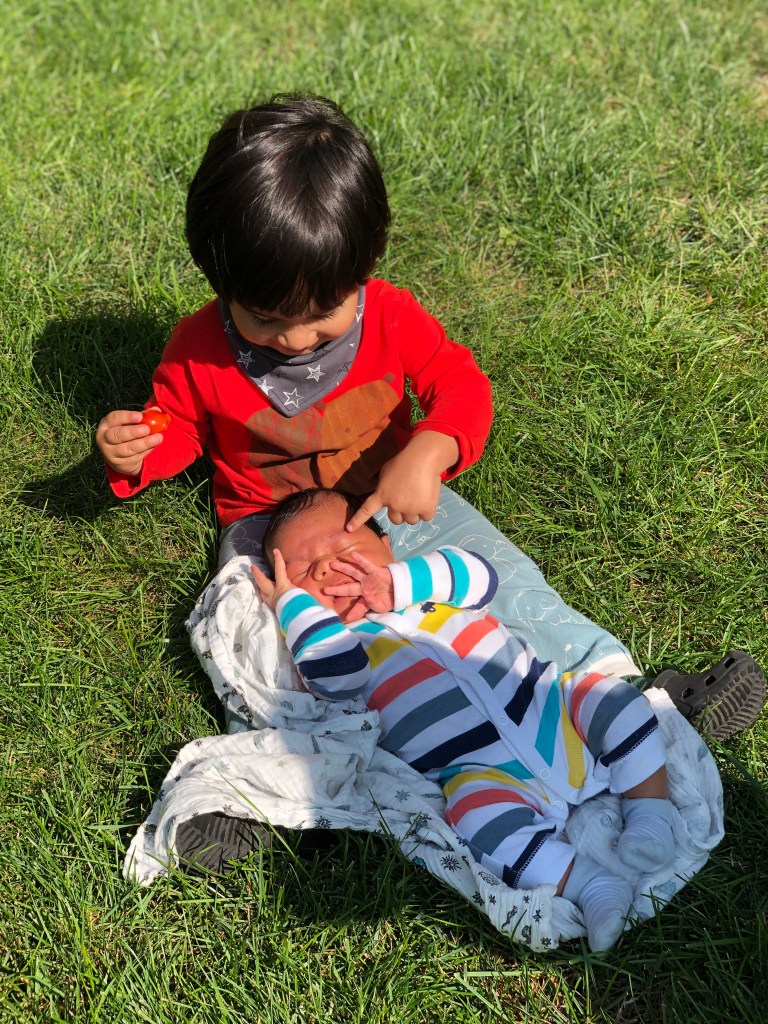
So here we were, my husband and I, figuring out life as parents of two lovely boys in the midst of COVID-19. Although we were fortunate to have had contact with my parents throughout the pandemic, I still felt completely isolated in my pregnancy. In my first pregnancy, I was surrounded by family, friends, and coworkers and my life felt so lively. The second time, I was not working and had very limited human contact. Looking back, I spent months feeling depressed during my second pregnancy without even realizing or accepting it in the moment. I was lucky to have seen my parents throughout the pandemic and to have had open space (parks, wooded areas, playgrounds) that allowed for time outdoors. I didn’t feel the right to be depressed when I had so much more than what many people around the world had access to. But still, isolation is not easy for anyone and dealing with raging pregnancy hormones made those months in the heat of the pandemic quite a bit more challenging.
COVID-19…how it turned the world upside down and it is just crazy to think how quickly we moved past it and settled back into normalcy, though the experience of it will have marked all of us in our own unique way.
 A Hybrid Life
Leave a comment